Telangana Builders Push for Farmhouse Plotting in Conservation Zones | Realty Insights
As Hyderabad’s real estate market booms outward, developers are pressing the state government to unlock conservation land for farmhouse layouts — reigniting a decades-old debate over growth versus environmental protection.
Realty Insights DeskFebruary 20268 min read
Telangana’s real estate developers are intensifying their lobby to allow farmhouse plotting and residential layouts within the state’s protected conservation zones — a push that has put economic opportunity on a collision course with environmental law and Hyderabad’s long-term water security.
The demand has been building for years, but recent months have seen the industry make its case with fresh urgency. With residential land inside Hyderabad’s Outer Ring Road (ORR) becoming scarcer and more expensive, builders are eyeing the vast conservation belts that ring the city — particularly the 540 sq km area governed by the landmark Government Order No. 111 (GO 111), a 1996 directive designed to protect the catchment areas of Osman Sagar and Himayat Sagar lakes.
The core ask from the Telangana Developers Association and other industry bodies is straightforward: allow the regulated development of farmhouse plots and gated farmhouse communities within conservation-zoned land, subject to strict green building and low-density norms. Proponents argue this would unlock economic value for landowners in 84 villages who have been sitting on largely undevelopable land for three decades, while also meeting a surge in demand for semi-rural lifestyle properties from Hyderabad’s growing tech workforce.
. 540 Square kilometres covered by Hyderabad’s GO 111 conservation zone, spanning 84 villages across Ranga Reddy district
. 90% Of the GO 111 area legally required to remain designated for conservation, recreation, and agriculture use
. 10 km Radius around Osman Sagar and Himayat Sagar within which GO 111 bans industries, hotels, and residential colonies
. 84 Villages in mandals including Shamsabad, Moinabad, Chevella, and Rajendernagar that fall under the GO 111 restriction
What Builders Are Asking For
Developers are not calling for the outright scrapping of GO 111 — a move that would be politically and legally explosive. Instead, the ask is more nuanced: permit low-density farmhouse plotting within specific sub-zones, with each plot meeting a minimum size threshold (typically 2,000 sq metres or 20 guntas), no concrete high-rises, mandatory green coverage requirements, and on-site sewage treatment plants (STPs).
The argument draws on a precedent the state itself has already partially set. After years of pressure, earlier governments began treating parts of the GO 111 area as a “multipurpose zone,” and municipal authorities in some areas started entertaining Change of Land Use (CLU) applications. Developers now want this policy signal formalised, clear, and consistent — offering both buyers and builders the legal certainty they need to invest.
“There is genuine demand from residents of these 84 villages who want development similar to the rest of Hyderabad. These landowners have effectively been frozen out of the real estate boom for 30 years.”— Telangana Developers Association (paraphrased from industry statements)
Under the current BuildNow (TG-bPASS 2.0) portal, which replaced the old TS-bPASS system for all building and layout approvals under GHMC, HMDA, and DTCP limits, layouts remain explicitly impermissible in Conservation Zones. Builders say this blanket prohibition is both economically damaging and increasingly out of step with ground reality — where informal development continues despite the official ban.
The Environmental Counter-Argument
Conservationists and water security advocates are pushing back hard. The two lakes — Osman Sagar (Gandipet) and Himayat Sagar — were built in the early 20th century and were Hyderabad’s primary drinking water source for decades. Though the city now draws most of its water from the Krishna and Godavari rivers, environmentalists warn that the lakes remain ecologically critical as recharge zones for groundwater and as buffers against flash flooding.
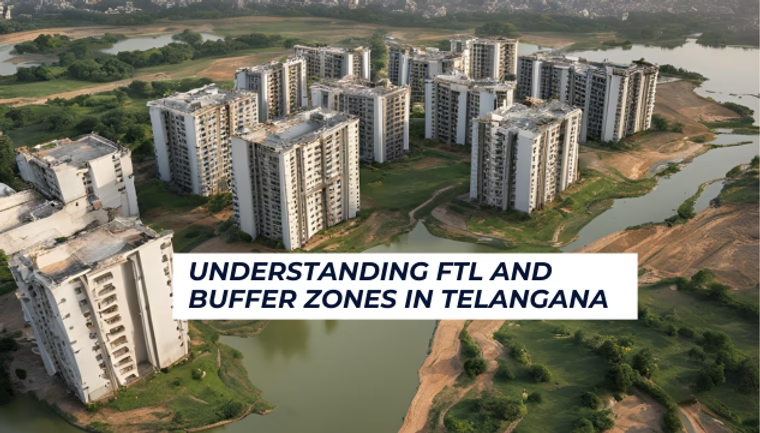
The Hyderabad Disaster Response and Asset Protection Agency (HYDRAA), constituted in July 2024, has been aggressively demolishing structures built in Full Tank Level (FTL) areas and buffer zones across the city. By late 2024, HYDRAA had conducted over 262 demolitions across 23 locations, recovering more than 111 acres of encroached land. This enforcement context makes any formal relaxation of conservation zone rules politically sensitive.
Key Regulatory Framework at a Glance
- GO 111 (1996): Prohibits residential colonies, industries, and major hotels within 10 km of Osman Sagar and Himayat Sagar. Reserves 90% of the area for conservation and agriculture.
- HMDA Master Plan 2031: Designates much of the surrounding area as Conservation (Agriculture) Use Zone; Bio-Conservation Zones are fully protected with no change of land use permitted.
- WALTA 2002: Empowers the Telangana Water Land and Trees Authority to notify heritage and conservation areas and regulate encroachments near water bodies.
- HYDRAA (2024): Active enforcement wing tasked with demolishing illegal structures in FTL and buffer zones and protecting public land from encroachment.
- BuildNow / TG-bPASS 2.0: Current approval portal; layouts are not sanctioned within Conservation Zones under existing rules.
The Supreme Court of India has also historically weighed in on the matter. A “precautionary principle” invoked by the apex court in 2000, when an industrial unit sought to operate within the catchment area, remains a significant legal barrier. Any state-level policy shift relaxing development norms in conservation zones risks a court challenge from environmental groups.
What This Means for Property Buyers
For buyers eyeing farmhouse plots in the outskirts of Hyderabad, the situation requires careful due diligence. The demand for weekend homes, eco-retreats, and lifestyle farms within an hour of the city is genuinely growing — property values in scenic locations near urban centres have appreciated 20–30% over the past five years according to industry observers. But purchasing land in or near a conservation zone without verified approvals carries serious legal risk.
What to Verify Before You Buy
Before investing in any farmhouse plot or rural residential land in Telangana, buyers should confirm the following with official documents:
Buyer’s Due Diligence Checklist
- HMDA Land Use Map: Verify whether the plot falls under Conservation Zone, Residential Zone (R4), Peri-Urban Zone, or Bio-Conservation Zone. The map is available through the HMDA Master Plan 2031 portal.
- HYDRAA FTL & Buffer Zone Map: Check that the plot is not within the Full Tank Level boundary or buffer zone of any lake or water body.
- Pattadar Passbook & ROR-1B: Confirm ownership title, land classification (agricultural or converted), and freedom from encumbrance.
- Encumbrance Certificate (EC): Verify the complete transaction history and absence of legal claims or loans against the property.
- Layout Approval: Confirm the layout is approved by HMDA or DTCP. Plots in unapproved layouts will not receive utility connections and face demolition risk.
- NALA Conversion (if applicable): For agricultural land being converted to non-agricultural use, ensure Non-Agricultural Land Assessment conversion is completed and valid.
- GO 111 Area Check: If the property is in Shamsabad, Moinabad, Chevella, Rajendernagar, or surrounding mandals, specifically check whether it falls within the GO 111 catchment zone.
The Bigger Picture: Farmhouses as an Asset Class
Beyond the regulatory debate, the appetite for farmhouse properties is undeniably real. As Hyderabad has become one of India’s fastest-growing tech and business hubs, a significant segment of its high-income population is seeking lifestyle properties that offer space, greenery, and a break from high-density urban living — without being too far from the city. Farmhouses in mandals like Shankarpally, Chevella, Moinabad, and Vikarabad have been attracting sustained interest.
Farmhouse plots have historically offered income potential through rentals for weddings, corporate retreats, and agri-tourism stays. With minimum plot sizes of 2,000 sq metres and low construction-to-land ratios, they also offer relatively straightforward appreciation plays in a market where flat inventories can be opaque.
However, the risk profile is different from urban residential property. Legal clarity is everything. The ongoing push by builders to expand into conservation zones also means that buyers who act before formal policy change is enacted — or worse, who buy land where informal development is happening despite the ban — could find themselves holding assets that face regulatory action.
“A farmhouse can be your gateway to calm, green living — but it must stand on a solid legal foundation. Before investing, confirm the land’s classification, get all permissions, and verify the documents.”— Real Estate Legal Advisory
Looking Ahead: What to Watch
The policy debate will likely intensify through 2026. The Telangana government under Chief Minister A. Revanth Reddy has been active in reshaping the state’s real estate regulatory landscape, launching the BuildNow portal and overseeing HYDRAA’s enforcement campaign. Whether that reform energy extends to a formal, structured policy for conservation zone development — versus continued ad-hoc CLU approvals — remains to be seen.
For industry observers, the most watched development will be whether the government frames any relaxation around strict environmental conditionalities — mandatory tree cover ratios, STP requirements, cap on impervious surface — or whether the push for development income erodes the conservation intent of GO 111 over time.
Either way, buyers and investors in this segment of the Hyderabad real estate market should treat regulatory clarity as a prerequisite, not an afterthought. In a landscape where HYDRAA is demolishing structures and the courts remain watchful, verified approvals are the only safe foundation for any investment in conservation-adjacent land.
GO 111 Timeline
1996 GO 111 enacted under CM N. Chandrababu Naidu to protect Osman Sagar & Himayat Sagar catchment areas
2000 Supreme Court invokes precautionary principle, blocking an industrial unit from operating in the catchment area
2017 Telangana state begins considering relaxation; real estate lobby escalates pressure
2022 CM KCR signals phased approach to GO 111 relaxation; environmentalists oppose and prepare SC petition
2023 State moves to treat GO 111 area as “multipurpose zone”; CLU applications begin to be entertained
2024 HYDRAA constituted; demolition drive begins in FTL and buffer zones across Hyderabad
2026 Builders renew push for formal farmhouse plotting policy in conservation zones under Revanth Reddy government
Quick Facts
Minimum farmhouse plot size for registration in Telangana: 2,000 sq metres (20 guntas)
Layout rules: Layouts are not permissible in Conservation Zones under current BuildNow / TG-bPASS regulations
Open space requirement: 60% of total area must be kept as open space and roads in catchment area layouts
HMDA Bio-Conservation Zones are fully protected — no change of land use is permitted under any circumstances
Considering a Farmhouse Investment?
Our property advisors can guide you through legal due diligence for rural and semi-rural plots around Hyderabad.Talk to an Advisor © 2026 Realty Insights · All content is for informational purposes only and does not constitute legal or financial advice. · Consult a qualified property lawyer before any land purchase.